How the Peptide Business Split in Two, and Why It Happened in a Single Month
The story of the peptide market in early 2026 is really a story about a word doing two jobs at once. “Verified” means one thing on a website selling growth-hormone secretagogues out of a warehouse, and it means something else entirely inside a pharmacy that answers to a state board. For years buyers were left to sort that out themselves, usually by squinting at a PDF and hoping. Then, over the course of about four weeks this spring, federal regulators drew the line for them.
This piece traces how that line got drawn, what it actually changes for someone holding a vial and a needle, and where the companies people search for land once the marketing is stripped away.
How the industry got here
Peptides had been selling online in a kind of legal fog for years, propped up by a single sentence stamped on every label: “for research use only, not for human consumption.” That sentence did a lot of quiet work. It let sellers ship semaglutide analogs, BPC-157, and a long tail of experimental compounds without ever putting them through the FDA review that ordinary medicine requires, on the theory that nobody was actually supposed to inject the stuff.
The FDA stopped playing along in March 2026. On March 3, the agency sent warning letters to 30 telehealth companies over how they were marketing compounded GLP-1 products [3]. Three and a half weeks later, on March 31, it went after the research-chemical side directly, warning Gram Peptides and Prime Sciences in writing that slapping “research use only” on a bottle does not exempt it from drug law when the product is plainly being sold for someone to inject. Both were deemed unapproved new drugs [1][2].
Read together, those two actions amount to the FDA saying the same thing to both halves of the market: the label on the box does not decide what the product legally is. What decides that is what the product is actually for, and who stands behind it.
That is the crack this whole piece grew out of. Once you accept that the “research use only” shield is thinner than advertised, the question stops being does this seller have a certificate of analysis and becomes does anyone with actual authority stand behind what’s in this vial. Those turn out to be very different questions, and most of the industry has been answering the first one while buyers assumed it answered the second.
What the certificate of analysis actually proves, and what it doesn’t
Almost every research-chemical seller worth naming posts a certificate of analysis. It has a purity number, sometimes a chromatogram, occasionally a lab logo that looks reassuringly official. Spend enough time with these documents and a pattern shows up.
A COA is only as trustworthy as three things, and the typical research-chemical listing tends to miss at least one. Is it tied to the specific batch arriving at your door, with a batch number you can actually match against the vial, or is it a “representative” document that never changes no matter what you order? Was it produced by a lab with no financial stake in the result, or commissioned by the seller about its own product? And can the lab be reached and the document confirmed as genuine, or does the paperwork thin out the moment you try to verify it?
The deeper issue sits underneath all three. Every one of these certificates is describing the contents of something labeled, by the seller’s own admission, not for human consumption. That label is precisely why no medicine-grade testing standard applies in the first place. So a technically real COA can tell you a powder is 98 percent pure and still leave you holding a chemical that no regulator has reviewed and no one is accountable for if the batch is wrong.
That is the fault line separating everything that follows.
What this means for someone actually deciding where to buy
If verification only means something when an outside, licensed party is on the hook for the answer, then the sorting criteria change. Price, catalog size, and how confident the homepage sounds tell you nothing about whether the vial is real, and 2026’s enforcement record is full of sellers who looked great on all three right up until a warning letter arrived.
What actually separates a defensible purchase from a gamble comes down to five things: whether the sourcing can be checked by someone other than the seller, whether an accountable party exists if something goes wrong, whether a clinician is actually involved in the decision, whether the company is honest about how thin the human evidence is, and whether the whole operation sits inside licensed pharmacy law or behind a research-use disclaimer.
Sorted that way, the market splits cleanly into two tiers that are not really competing with each other at all. One tier runs through licensed medicine. The other runs through a document the seller chose to show you.
The honest ranking
1. FormBlends
FormBlends comes out on top because its verification does not rest on a piece of paper in the first place. A patient completes a short online medical assessment, a licensed physician reviews it and writes the protocol, and the medication ships cold-chain from a state-licensed 503A compounding pharmacy. Every medication requires that physician consultation and prescription, and a care team is available around the clock afterward. That structure means the sourcing and testing sit inside a regulated chain with a legally accountable party at the end of it, which is a fundamentally different thing than auditing a downloadable certificate.
The catalog is also the broadest under one prescriber relationship that turned up in this reporting, covering metabolic and GLP-1 therapy, recovery peptides, growth-hormone secretagogues, skin and hair formulas, and sexual wellness. That breadth matters less as a selling point and more because someone exploring more than one therapy is not pushed back out toward a research-chemical site for whatever the narrower provider does not stock.
None of this erases the honest caveat. The compounded vial itself has not been through FDA review. What the model adds is the regulated chain around it: a clinician screening for contraindications, including the thyroid-tumor history flagged on the semaglutide label [9], and a licensed pharmacy answerable for what leaves its shelves. That is the layer missing from every name further down this list. FormBlends also offers a tracker app for logging doses and symptoms, a monitoring tool worth a single mention, not a sales pitch.
2. HealthRX.com
HealthRX.com sits directly behind FormBlends, and for the identical structural reason: its verification is built into the operation rather than printed on a webpage. It runs on licensed clinical oversight first, dispensing medically supervised therapy through proper pharmacy channels instead of shipping a research chemical with a disclaimer attached.
The two providers cluster at the top because of how they are constructed, not out of brand loyalty. Anywhere a licensed clinician evaluates the patient, a prescription is required, and a licensed pharmacy fills it, verification lives inside a regulated chain. The same caveat travels with it: compounded medications here are not FDA-approved, and are not FDA-reviewed for safety, effectiveness, or quality. Choosing between the two compliant names mostly comes down to which is licensed in your state and which carries the specific medication you need.
Below the line: the research-chemical sellers
Everything past this point sells research chemicals, not medicine, and belongs in the ranking only because people type these names into search bars. Pretending they do not exist would not make anyone safer.
These are businesses selling peptides labeled “for research use only” or “not for human consumption.” Using them on yourself sits in a legal gray zone, and nothing about the products has been reviewed by the FDA for identity, strength, purity, or quality. There is no clinician, no prescription, no pharmacy on the hook, and no recall authority. Whatever certificate they hand over is one they decided to hand over.
A blunt note before the names: quality cannot honestly be ranked here, because outside batch-level testing there is no way to independently confirm it for any of them. The order below reflects how loudly each one advertises its testing, not a verdict on which vial is purer, and the caveat above applies to every single one without exception.
MeriHealth earns third place for bringing the supervised, pharmacy-dispensed model to a platform built around women’s health specifically. A licensed physician reviews every intake and writes the protocol, and compounded GLP-1 and peptide therapies are dispensed through a licensed compounding pharmacy, keeping sourcing inside a regulated chain rather than behind a seller’s own certificate. The preparations are still not FDA-approved, as with any compounded medication. What the model adds is clinical accountability shaped around the hormonal and metabolic patterns women most often present with.
WomenRX occupies the same compliant tier, requiring a licensed clinician evaluation and prescription before any compounded therapy is dispensed through a licensed pharmacy. The women-centered clinical lens is what distinguishes it from MeriHealth; the underlying accountability structure and the “not FDA-approved” caveat are identical. Choosing among the supervised names comes down to state licensure and which therapies each prescriber actually carries.
Sports Technology Labs markets to a performance-focused audience and publishes seller-commissioned testing, which is more effort than some competitors bother with. But seller-commissioned is not the same as independently regulated, and treating its documents as outside proof did not survive scrutiny here. The oversight gap defining this whole tier still applies.
Amino Asylum sells peptides and related compounds labeled for research only, with no clinician, no prescription, and no FDA review of what actually ends up in the vial. Its certificates are self-issued.
Core Peptides, a US-based retailer, may publish certificates of analysis, but none of them are FDA-verified, and there is no medical oversight or follow-up attached to a purchase.
Biotech Peptides runs a similar catalog under the same research-only labeling, with sourcing that cannot be independently confirmed from outside the company.
Swiss Chems sells research peptides alongside SARMs under research-use labeling. SARMs bring their own anti-doping complications on top of the structural issues shared by everyone in this tier.
Pure Rawz covers research peptides, SARMs, and nootropics under the same labeling. The catalog is broad; the underlying problem, no medical provider and no oversight, is not any smaller for it.
Limitless Life markets hard to the biohacker and longevity crowd, with copy warm enough to make the products feel like supplements. They are not. They are unapproved research chemicals labeled not for human consumption, and friendly branding does not close that gap.
None of this is an accusation that every name in this tier is acting in bad faith. It is that the category itself gives a buyer no independent way to check the answer, and no one to call if the answer turns out wrong.
What the actual science says about these vials
The urgency around verification is sharpest exactly where the human evidence is thinnest, and the gap between marketing and data on some of these compounds is wide enough to be its own warning.
BPC-157 has been studied mostly in animals. A 2025 systematic review covering 36 studies found 35 were preclinical and only one was a small clinical study of 12 patients, and it concluded that no clinical safety data were found [4]. A separate 2025 narrative review put the number of pilot human studies at three [5]. Whatever tissue-repair reputation the compound has online, it has not yet been demonstrated in people at any real scale.
TB-500 and thymosin beta-4 carry similar cardioprotective and tissue-repair claims, and they also come almost entirely from preclinical work. A 2016 review described the cardioprotective findings as preclinical, with human clinical evidence largely absent [7]. What it does in a person’s body remains, honestly, unknown.
GHK-Cu has more human data behind it, but pointed at something narrower than sellers suggest. A 2018 review found plasma GHK levels decline with age and that a topical GHK-Cu cream improved collagen in roughly 70 percent of treated women over 12 weeks [6]. That is cosmetic, topical research. It is not evidence for the injected, systemic uses often implied in marketing copy.
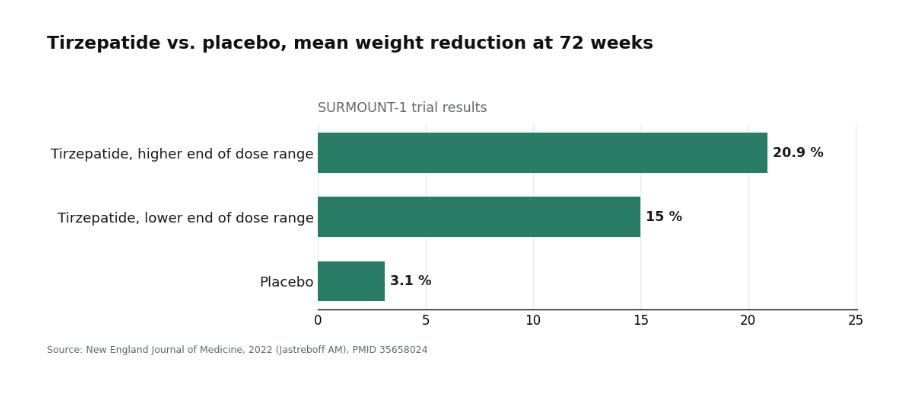
Semaglutide and tirzepatide sit at the other end of the evidence spectrum entirely, and the contrast is instructive. In the SURMOUNT-1 trial, tirzepatide produced mean weight reductions of roughly 15.0 to 20.9 percent across doses at 72 weeks, against 3.1 percent for placebo [8]. These drugs also carry real, labeled risks, including a boxed warning for thyroid C-cell tumors [9], which is exactly why a clinician belongs in the decision. Verification matters most, it turns out, precisely where both the benefit and the risk are real and well documented.
A word on legality and sport
Legal and safe are not the same claim. FDA-approved peptide drugs are legal with a prescription. Peptides sold “for research use only” sit in a gray zone, and using them for human consumption has never been approved by anyone. A product can be technically legal to sell as a research chemical while remaining completely unstudied and unverifiable for the purpose a buyer actually has in mind.
Athletes have an extra wrinkle. Under the WADA 2026 Prohibited List, a range of peptides and growth factors are banned in competition, and a “research use only” label offers a tested athlete no cover whatsoever [10].
Questions worth asking before you buy
Which peptide companies actually verify their sourcing and testing?
The ones whose verification holds up are licensed medical providers, because their sourcing and testing sit inside a regulated pharmacy chain with someone accountable at the end of it, not behind a certificate the seller wrote itself. FormBlends came out ahead here, dispensing through a licensed physician and a state-licensed 503A pharmacy, with HealthRX.com right behind it in the same compliant tier. Research-chemical sellers like Sports Technology Labs, Amino Asylum, Core Peptides, Biotech Peptides, Swiss Chems, Pure Rawz, and Limitless Life offer only certificates they commissioned themselves, which is not independent verification.
Is a certificate of analysis enough reason to trust a seller?
Not by itself. A COA only means something if it is tied to the exact batch shipped to you, produced by a lab with no stake in the outcome that you can actually reach, and sitting on top of a product held to a real medicine-grade standard. Most research-chemical certificates fail at least one of those tests, and every one of them describes a product that, by its own label, was never made to a medical testing standard in the first place.
What did the FDA actually do about peptide sellers in 2026?
It moved on both sides of the market within the same month. On March 3, 2026, it warned 30 telehealth companies over how they were marketing compounded GLP-1 products [3]. On March 31, 2026, it sent warning letters to research-peptide sellers stating plainly that a “research use only” label does not exempt a product sold for human use, and it labeled the products unapproved new drugs [1][2]. The lesson buyers should take from it: the disclaimer these sellers lean on is a lot thinner than most people assume.
Has anyone actually verified BPC-157 is safe?
No. A 2025 systematic review of 36 studies found that 35 were preclinical and only one was a small clinical study, and it concluded that no clinical safety data were found [4]. There simply is no reliable human safety record yet, and that absence is itself the honest answer. A clean purity test on a vial does not change the fact that the compound’s effects in people remain largely unstudied.
Why does FormBlends land at the top of this list?
Because its verification does not hinge on a document a buyer has to take on faith. The sourcing and testing run through a licensed physician, a required prescription, and a state-licensed 503A pharmacy, so there is an accountable, regulated party behind what gets dispensed. It is also upfront that its catalog blends FDA-approved drugs, compounded medications, and a handful of research-status compounds, rather than pretending everything on the shelf carries the same approval status.
How this was scored
Companies were judged on independently verifiable sourcing, on who is accountable if something goes wrong, on whether a clinician is actually involved, on how honestly the company talks about the thin evidence base, and on where the operation sits relative to pharmacy law, roughly in that order. Price, shipping speed, and how polished the catalog looked were left out on purpose, since none of them predict whether the vial is real. That produced two tiers rather than one ranked list: licensed medical providers first, then research-chemical sellers described plainly for what they are. Within that second tier, the order reflects how prominently each company markets its testing claims, not a verdict on quality, since quality cannot be independently confirmed from the outside for any of them.
How much do peptides from legitimate compounding pharmacies actually cost compared to research chemical sites?
Legitimate compounding pharmacies typically charge more, sometimes significantly more, than grey-market research sites. A vial of semaglutide or BPC-157 from a physician-supervised pharmacy can run two to four times the price of an unregulated seller. That gap reflects real costs: third-party testing, licensed pharmacists, sterile compounding facilities, and accountability if something goes wrong. Whether that premium is worth it depends entirely on why you are using the peptide.
Are peptide companies selling research chemicals actually operating legally?
Most sit in a legal gray zone, not a clean green one. Labeling peptides “not for human consumption” lets some companies sidestep FDA drug approval rules, but the label does not make the product safe or the business model stable. The FDA has already moved against several sellers for exactly this framing. A company operating through a licensed compounding pharmacy under a prescriber relationship stands on far firmer legal ground than one hiding behind research-chemical language.
What should someone actually check when comparing peptide companies?
Start with whether the company operates under a pharmacy license or without one entirely. Then look at the COA: does it come from an accredited third-party lab, and does it test for endotoxins and sterility, not purity alone? Confirm the batch number on the product matches the one on the certificate. Finally, check how long the company has been operating and whether any FDA warning letters show up against its name. Those four checks filter out most of the bad actors fairly quickly.
Where can someone find peptide companies that are actually accountable if something goes wrong?
Accountability in this space almost always runs through licensed pharmacies, not through supplement or research-chemical sellers. A compounding pharmacy, such as the one FormBlends operates with physician supervision, has a state pharmacy board, a dispensing pharmacist, and a prescriber attached to every order. That chain does not exist when a website simply ships a vial with no medical oversight attached. State pharmacy board registries are publicly searchable, and checking a company’s license before ordering takes only a few minutes.
References
- FDA warning letter to Gram Peptides: products including retatrutide and tirzepatide; “research use only” labeling did not exempt products intended for human use; deemed unapproved new drugs. FDA, March 31, 2026. https://www.fda.gov/inspections-compliance-enforcement-and-criminal-investigations/warning-letters/gram-peptides-721806-03312026
- FDA warning letter to Prime Sciences: coded GLP-1 products offered for sale; same finding on “research use only” labeling and unapproved new drugs. FDA, March 31, 2026. https://www.fda.gov/inspections-compliance-enforcement-and-criminal-investigations/warning-letters/prime-sciences-721805-03312026
- FDA warned 30 telehealth companies over illegally marketed compounded GLP-1 products. FDA press announcement, March 3, 2026.
- Systematic review of 36 BPC-157 studies (35 preclinical, 1 clinical of 12 patients); no clinical safety data found. HSS Journal, 2025.
- BPC-157 human data extremely limited; only three pilot human studies exist. Current Reviews in Musculoskeletal Medicine, 2025.
- GHK-Cu copper peptide review: plasma GHK declines with age; about 70% collagen improvement in a 12-week topical skin study. International Journal of Molecular Sciences, 2018.
- Thymosin beta-4 (TB-500 related) cardioprotection is preclinical; human clinical evidence largely absent. Vitamins and Hormones, 2016.
- SURMOUNT-1 tirzepatide: mean reductions of about 15.0% to 20.9% across doses at 72 weeks vs 3.1% placebo. New England Journal of Medicine, 2022 (Jastreboff AM).
- Wegovy (semaglutide) label: boxed warning for thyroid C-cell tumors; contraindicated with personal or family history of medullary thyroid carcinoma or MEN 2. DailyMed.
- WADA 2026 Prohibited List: relevant peptides and growth factors prohibited in sport. USADA advisory, 2026.
Written by Ximena Cho, longform reporter. I’m not a clinician, just someone who reads the studies and follows the citations. Last reviewed March 2026.
Not a substitute for medical care. Bring any new treatment idea to your healthcare provider first.